Medication Management
2020 -2022
The implemented solutions have proven to improve clinical efficiency, reduce medication errors, and contribute to safer, more responsive patient care. The results were showcased in several webinars (e.g., openEHR & Medication Management – EPS Case Study) and received national recognition in the UK:
+ HSJ Digital Awards 2024: Winner – Improving Medicines Management and Pharmacy Through Digital
+ HTN Awards 2023: Partnership of the Year
+ Health Tech Awards 2022: Excellence in Project Management
Redesigning the Medication Prescribing Interface
As the Design Lead for the digitalization of electronic prescribing, I spent two and a half years designing complex solutions to upgrade one of the most advanced Electronic Prescribing and Medicines Administration (ePMA) and electronic health record systems on the market. The system is built on the openEHR standard and interoperable models, including FHIR and HL7.
The platform is actively used in clinical settings across hospitals in the UK (NHS), Spain, Australia, and Slovenia (UKC Ljubljana). The project encompassed a series of interconnected design iterations where, as the principal (and often sole) designer, I took ownership of the entire end-to-end design process: from user research to implementation and on-site field testing. I collaborated closely with developers, product managers, clinical advisors, pharmacists, doctors, and nurses—both remotely and during field visits (e.g., Somerset NHS Foundation Trust).
Resolver benefit
Defining scope & iterations
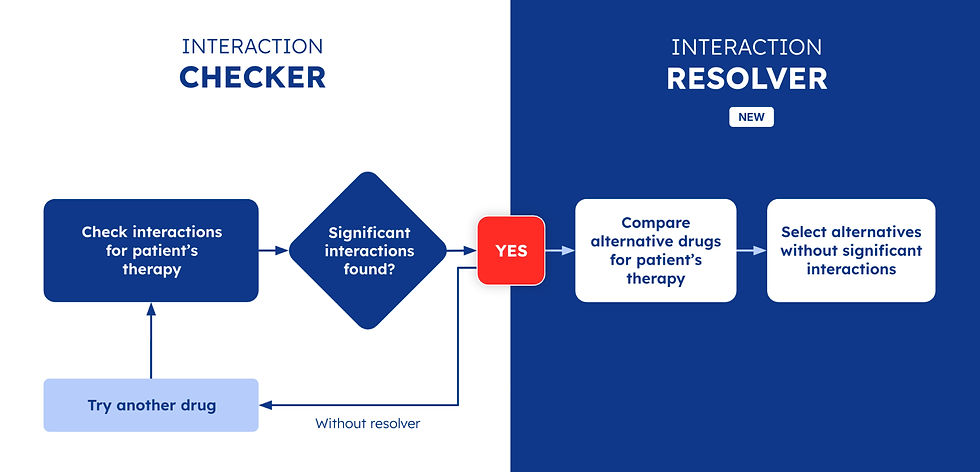
To keep the problem manageable, we split development into two iterations:
-
Interaction Checker — identified potential drug interactions
-
Interaction Resolver — suggested alternative drugs that caused fewer or no interactions
Steps


Designing for clarity
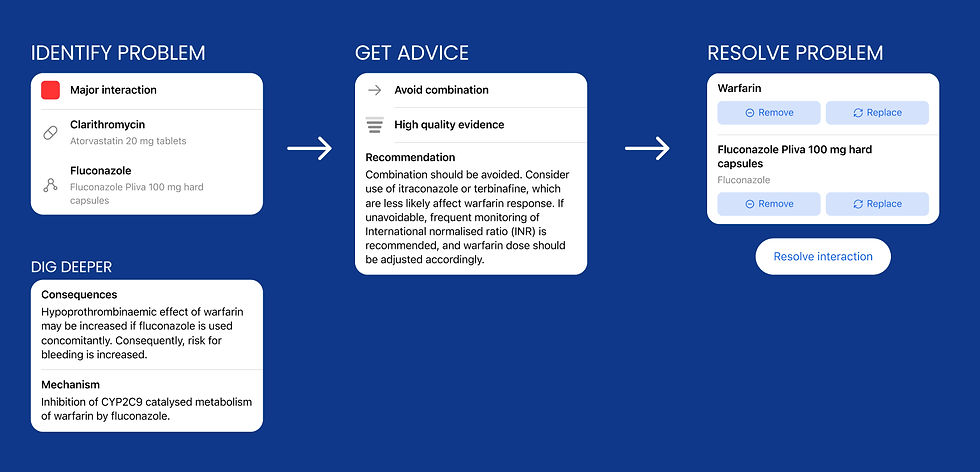
Instead of overwhelming doctors with complex numerical values, we simplified the interface using color coding and focused on only the most essential details:
-
Severity
-
Consequences
-
Next steps
-
Option to resolve
Product vision created with PMs, CEO, and CPO.
Reducing cognitive load
This approach saved doctors time and effort, especially when dealing with drugs they were less familiar with, by automatically surfacing safe alternatives instead of requiring manual searches.
Polypharmacy

Future-proofing
From the start, we planned extensibility. The Interaction Resolver was later upgraded with optical recognition. The core idea also served as the foundation for future vision types of a comprehensive Therapy Reviewer that evaluates not only drug interactions, but also restrictions and contraindications, while integrating patient-specific data to support truly personalized treatment decisions.
Competition analysis
